Posts

Showing posts with the label Advice Column

[Advice Column] Research summary: Quality in assessment - the meaning and consequences of standards

Hey y'all! I've been pretty quiet lately - as predicted uni work really  caught up with me and I'm constantly running against the clock. This post is NOT intended for students. It's intended for teachers who are interested in different ways of thinking about summative  assessments as well as public examinations. We're going big here. That being said, I've finally finished reading one of my favourite papers from Dylan Wiliam, a key figure in assessment research, and spent a bit of time digesting what I've read. The paper is titled "Quality in assessment: The meaning and consequences of standards". It should be available for free, online, on Research Gate, but of course you can get your hands on it elsewhere. This is my first time sharing my research notes with y'all, so let me know how it goes. Instead of making this post dreadfully long, I've put the link to the google docs with the summary here . Enjoy! N23 students:  may the odds be ever ...
[Advice Column] What makes a question hard?

Image
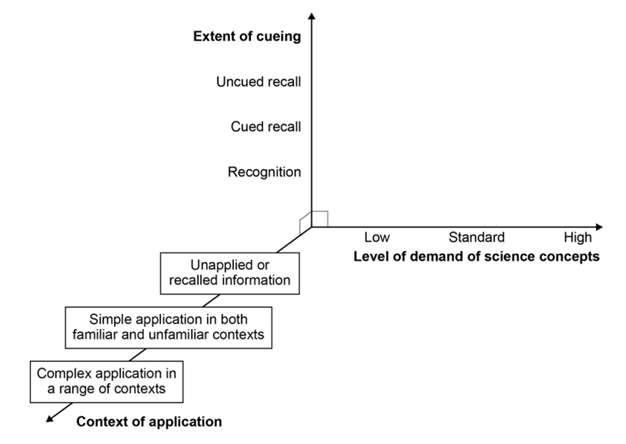
Hello hoomans. My long-time readers may have noticed that I tend to take all of us on a tangent every so often. And today happens to be one of those days.   If you hang out with me on the IB Discord server this is not the first time I babble on designing and writing examinations. You know how happy I am to talk about these nerdy things. I wrote two posts on how I write exams, which you could find here and here . Today we’ll take a crucial aspect – question difficulty – and dive deeper into what makes up the difficulty of a question.   This is my attempt to distill some of the research I’ve read in a more user-friendly, digestible way. Perhaps not the most accurate but hopefully they serve as a checklist for question writers to be cognizant of when they’re writing questions for a mock exam.   Note that this does NOT apply to formative assessments; the purpose is different and therefore you shouldn’t apply what’s written here word by word. And if you’re no...

[AISL][AASL] AISL to AASL: da transition

Tell me if this sounds familiar. Summer before IB, submitting your subject choice: aIsL iS sO eASy iMmA gEt a 45 Summer before DP2, looking at uni requirements: oh FUCK me no uni accepts this bird course!   Panik panik panik. Proceed to ask (read: beg) the coordinator to move you to AASL to get into the major you want to pursue. They raise their eyebrows, looking a little suspicious, really doubt if you could make it. But most likely they’re gonna say yes. You’ve got their green light, jumping in joy. September comes by, you see “the chain rule” on the board and proceed to read it as hieroglyphs.   Welcome to AASL.   Getting their permission is the first step. Now the hard part arrives: how to catch up with your classmates and how to come across as not totally out of your depth.   Today’s post focuses on the transition from AISL to AASL. The key things you should know to make the transition a little less bumpy.   (1) difference...

[Exam Strategies] Using and abusing hints

Image
Exam writers are nice people. Apart from me, of course. Quite often you’re receiving hints and nudges to keep you in the right direction. A couple times in section A and almost every question in section B. Since IB is a lil annoying with copyright I’ll take screenshots from A-level exams, but of course IB also does this.   Answers already given In some sub-questions you’ll see the correct answer already printed, coming after “Show that”. This question is taken from Edexcel A-level Maths October 2021.   Because the answer is given, you must make your method extremely clear to the marker. If they have a slightest suspicion you fudge your way to the answer they may choose to withhold the last mark (or the only mark in this case).   I’m now at the stage that I could kinda fudge my way to show a printed result – but that’s after a ton of practice and a vague idea of what I’m doing. You’re more than encouraged to use the printed answer to guide your work, bu...

Different grading systems

Image
Hello everyone!   Today’s post will deviate from the usual blogposts on the website, as it’ll be targeted at teachers and fellow tutors. I’m sure students can still benefit from this, but this post is written with teachers in mind.   We’ll discuss two main systems – numerical (raw) marks vs marking at the question level as a whole. This may sound confusing but it’ll make sense when you finish reading the post.   A brief rundown of the two systems   Numerical marks converted to final grade This is the most common method. A-level, IB, Scottish qualifications, it’s not hard to list systems that opt for this option.   Each exam has a fixed number of raw marks. Students take the exam, teachers mark each question and tally up the final raw mark.   The overall performance is not determined until the awarding process takes place.   Marking at the question level The biggest example of this is New Zealand’s NCEA system, fi...

The art of timing

Image
 9:00 a.m. Outside the exam room.   Your heart wants to explode, beating 200 times a minute.   You did the most revision you could do. You set 69 alarms to make sure you wouldn’t rush to school. You’ve prayed 420 times in the last hour, hoping to get some support from the universe.   Ah yes, the teacher’s finally here. Opening the classroom doors so you can all settle down. The scary sound of the paper knife ripping the paper folder opening. Your fate depends on the very papers in there. Five minutes later, you have them in front of you, quickly flipping through to look for missing pages, but slowly enough so you could attempt to peak at the actual questions. Looks like the budget this year is a little tight. The papers are a little thinner than usual. There are smudges on every other page. “You could’ve done better, smh”   Being bored, you start reading the cover page for the 101th time. 2 hours, 110 marks.   Let’s get to the poin...

How to keep swimming when motivation hits rock bottom?

Hewwo hoomans.   DP2 folks who just finished their exams, hope y’all are happy with your performance. Enjoy the summer before uni. Don’t try to get ahead; you’ll be suffocating in week 5 in your first semester anyway. Really, just enjoy the summer.   This is brought to you by a suffering third year student.   DP1s: exams are right around the corner. The last thing between you and summer. Motivation hits rock bottom. Frustrated at that nasty integral you’ve been struggling for a solid half hour. Really tempted to give up.   Been there, done that. There are moments that I don’t want to study at all . My rational self shouting at me, “DOOO IT YOUR FUTURE SELF WILL THANK YOU,” but my emotional self wins every time “Eh it’s not the end of the world, I’m happy with a B, thank you very much.” Knowing what to prioritise is a skill itself.   Me and bio, in a nutshell. We don’t flow together. Like Teflon and water, immiscible.   Let’s cut to the...

Surviving Trigonometry

Hewwo! I've been AFK on advice-column lately. Or longly. Let's change that. A couple weeks before exam season, it's quite alarming that many people have ZERO clue what the fuck they're doing. Especially in trigonometry territory. Wait, who am I and why should you listen to me? For those who are new to the IB server and/or the website, I hate trigonometry. I really do. I hate it so much that every exam season I have to rope my friend CreativeUsername into doing a revision session with me, on trigonometry, on the IB server. He never ceases to make fun of my toxic relationship with trigonometry. I have proofs. Trigonometry is easy... if you know what you're doing. Luckily this is where most people are dragged down. Warren Buffett once said "Be greedy when the market is fearful and be fearful when the market is greedy", you'll reap the most when acing the topic that most people want to deny its existence. As a proud survivor, I'm gonna lay all my cards...

[Advice Column] 8-week study plan!

Image
Hello hello! I haven't been posting much on the site lately. Having a backlog of mocks to write and a fair share of the assignments to do puts writing blogs (this one, right here!) on the back burner. Hats off to writers who could keep up their momentum because I simply couldn't force myself to write when I don't have ample of time at my disposal. Today's blogpost is mainly for N22 kiddos who will stop become kiddos (in my eyes) and prolly start university in February or after their gap year. With 8 weeks left before the exam, it's a not too early to start preparing for your externals. These advice are targetted at maths, but I reckon they are useful for other courses you're taking as well. Here's my top secret process to ace your exams. Aight, let's stop pretending that it's some sort of magic trick but it's certainly worked for me even in uni. Step 0:  Have a copy of the syllabus and the M21 papers, digitally or physically. This will avoid the ...