Posts

Showing posts with the label Assessments

[Random Musings] More on grading systems: compensatory model vs mastery model

Assessment Theory 101: Compensatory vs Mastery Model Hi everyone, This post is more targeted at fellow teachers, tutors and assessment enthusiasts, but of course students are welcome to learn more about the various grading systems. Today's post is on compensatory model vs mastery model. For simplicity, compensatory model is often used in external assessments in many countries, but there's nothing stopping us from adopting the mastery model on end-of-unit assessments in class. To keep it simple, let's consider a short end-of-unit test on logarithms consisting of three topics: use properties of logarithms to simplify expressions solve exponential and logarithmic equations solve modelling problems involving exponential and logarithmic functions Each topic is worth 10 marks, giving a total of 30 marks for the whole paper. The pass mark is 50%, so 15/30 marks. Notice that there's a LOT of paths that would get students to 15/30. To illustrate my point later on, we'll cons...
[Advice Column] Research summary: Quality in assessment - the meaning and consequences of standards

Hey y'all! I've been pretty quiet lately - as predicted uni work really  caught up with me and I'm constantly running against the clock. This post is NOT intended for students. It's intended for teachers who are interested in different ways of thinking about summative  assessments as well as public examinations. We're going big here. That being said, I've finally finished reading one of my favourite papers from Dylan Wiliam, a key figure in assessment research, and spent a bit of time digesting what I've read. The paper is titled "Quality in assessment: The meaning and consequences of standards". It should be available for free, online, on Research Gate, but of course you can get your hands on it elsewhere. This is my first time sharing my research notes with y'all, so let me know how it goes. Instead of making this post dreadfully long, I've put the link to the google docs with the summary here . Enjoy! N23 students:  may the odds be ever ...

[Advice Column] What makes a question hard?

Image
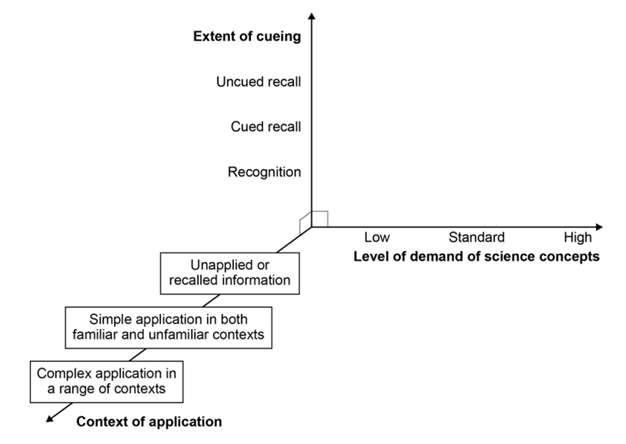
Hello hoomans. My long-time readers may have noticed that I tend to take all of us on a tangent every so often. And today happens to be one of those days.   If you hang out with me on the IB Discord server this is not the first time I babble on designing and writing examinations. You know how happy I am to talk about these nerdy things. I wrote two posts on how I write exams, which you could find here and here . Today we’ll take a crucial aspect – question difficulty – and dive deeper into what makes up the difficulty of a question.   This is my attempt to distill some of the research I’ve read in a more user-friendly, digestible way. Perhaps not the most accurate but hopefully they serve as a checklist for question writers to be cognizant of when they’re writing questions for a mock exam.   Note that this does NOT apply to formative assessments; the purpose is different and therefore you shouldn’t apply what’s written here word by word. And if you’re no...

Different grading systems

Image
Hello everyone!   Today’s post will deviate from the usual blogposts on the website, as it’ll be targeted at teachers and fellow tutors. I’m sure students can still benefit from this, but this post is written with teachers in mind.   We’ll discuss two main systems – numerical (raw) marks vs marking at the question level as a whole. This may sound confusing but it’ll make sense when you finish reading the post.   A brief rundown of the two systems   Numerical marks converted to final grade This is the most common method. A-level, IB, Scottish qualifications, it’s not hard to list systems that opt for this option.   Each exam has a fixed number of raw marks. Students take the exam, teachers mark each question and tally up the final raw mark.   The overall performance is not determined until the awarding process takes place.   Marking at the question level The biggest example of this is New Zealand’s NCEA system, fi...