Posts

[AAHL] Complex Numbers [Unit Test v2]

Hey there DP2s! For many of you school’s about to start in a week or two. If you have taken a fair mathematical sabbatical, perhaps this is time to prepare yourself for the new school year. I’m not a fan of studying from dawn till dusk every day, but the more work you could do now the more your future self will thank you when January hits.   Today we’ll be back with complex numbers. Similar to integration, complex numbers are not conceptually demanding but rather seasoned question writers love to weave other parts of the curriculum – trigonometric relationships, vectors, integration, you name it. Enjoy the complexity of your complex numbers!
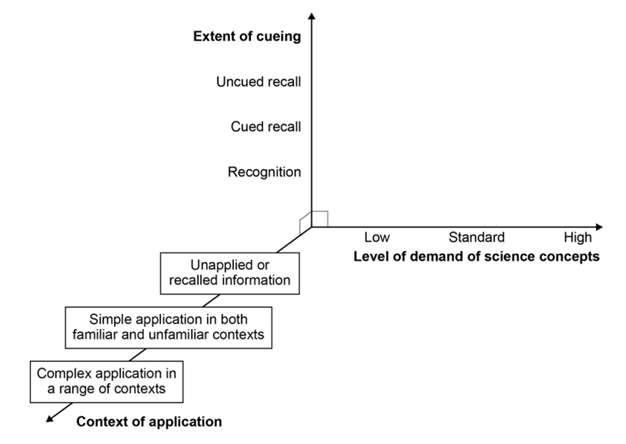
[Advice Column] What makes a question hard?

Image
Hello hoomans. My long-time readers may have noticed that I tend to take all of us on a tangent every so often. And today happens to be one of those days.   If you hang out with me on the IB Discord server this is not the first time I babble on designing and writing examinations. You know how happy I am to talk about these nerdy things. I wrote two posts on how I write exams, which you could find here and here . Today we’ll take a crucial aspect – question difficulty – and dive deeper into what makes up the difficulty of a question.   This is my attempt to distill some of the research I’ve read in a more user-friendly, digestible way. Perhaps not the most accurate but hopefully they serve as a checklist for question writers to be cognizant of when they’re writing questions for a mock exam.   Note that this does NOT apply to formative assessments; the purpose is different and therefore you shouldn’t apply what’s written here word by word. And if you’re no...

[AISL][AASL] AISL to AASL: da transition

Tell me if this sounds familiar. Summer before IB, submitting your subject choice: aIsL iS sO eASy iMmA gEt a 45 Summer before DP2, looking at uni requirements: oh FUCK me no uni accepts this bird course!   Panik panik panik. Proceed to ask (read: beg) the coordinator to move you to AASL to get into the major you want to pursue. They raise their eyebrows, looking a little suspicious, really doubt if you could make it. But most likely they’re gonna say yes. You’ve got their green light, jumping in joy. September comes by, you see “the chain rule” on the board and proceed to read it as hieroglyphs.   Welcome to AASL.   Getting their permission is the first step. Now the hard part arrives: how to catch up with your classmates and how to come across as not totally out of your depth.   Today’s post focuses on the transition from AISL to AASL. The key things you should know to make the transition a little less bumpy.   (1) difference...

[AAHL][AASL] The Ultimate Study Plan

This is an important blogpost. This is your roadmap to make your DP exams your bitch. Welcome to the ultimate Study Plan!   Over the last two weeks I’ve mapped out the sequence of topics y’all should revise from the start of DP2. Of course, if time’s not on your side, you can simply speed up what I’ve presented here – instead of studying 2-3 1h sessions a week you might want to do 4-6, but that’s entirely up to you.   Starting early is the easiest way to ensure you have a solid foundation when February comes (and normally that’s your 2 nd round of mocks. From February to April, that’s when you put everything you’ve learned to use – this is the time to start cramming past papers, my mocks, other mocks, get your hands on as many quality papers as possible. And when May comes around, you’re confident walking into the exam hall, ready to boss your exams.   As usual, there will be two sets of mocks this year (unless I’m too knackered) – one in mid-September ...

[AAHL][AASL] Logs and exponential [Unit Test v2]

Image
Hello hello! I'm bacc with my favourite topic in the course: logs! Here's some logs for you. Jokes aside, you'll see logs poppin' up everywhere in the course, especially AAHL. Integration, yup. Exponential equations, yup. Modelling, yup. Sequences and series, totally. Without any further ado, allow me to present the second round of logs tests! You may have noticed I got a little softer and let you have a little more time. Ultimately, I want you to show off what you can do, so you should be relatively fast but not  rushing. AASL: AASL Answers: AAHL: AAHL Answers: May the odds be ever in your favour. c: Enjoy your summer and remember to spend some times touching logs (or grass, whatever you prefer!)

[Exam Strategies] Using and abusing hints

Image
Exam writers are nice people. Apart from me, of course. Quite often you’re receiving hints and nudges to keep you in the right direction. A couple times in section A and almost every question in section B. Since IB is a lil annoying with copyright I’ll take screenshots from A-level exams, but of course IB also does this.   Answers already given In some sub-questions you’ll see the correct answer already printed, coming after “Show that”. This question is taken from Edexcel A-level Maths October 2021.   Because the answer is given, you must make your method extremely clear to the marker. If they have a slightest suspicion you fudge your way to the answer they may choose to withhold the last mark (or the only mark in this case).   I’m now at the stage that I could kinda fudge my way to show a printed result – but that’s after a ton of practice and a vague idea of what I’m doing. You’re more than encouraged to use the printed answer to guide your work, bu...

Different grading systems

Image
Hello everyone!   Today’s post will deviate from the usual blogposts on the website, as it’ll be targeted at teachers and fellow tutors. I’m sure students can still benefit from this, but this post is written with teachers in mind.   We’ll discuss two main systems – numerical (raw) marks vs marking at the question level as a whole. This may sound confusing but it’ll make sense when you finish reading the post.   A brief rundown of the two systems   Numerical marks converted to final grade This is the most common method. A-level, IB, Scottish qualifications, it’s not hard to list systems that opt for this option.   Each exam has a fixed number of raw marks. Students take the exam, teachers mark each question and tally up the final raw mark.   The overall performance is not determined until the awarding process takes place.   Marking at the question level The biggest example of this is New Zealand’s NCEA system, fi...